Sunday, 26 July 2009

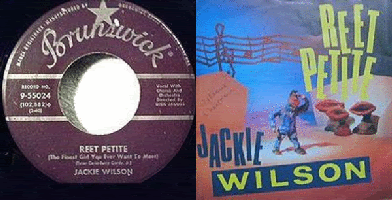
1986 Jackie Wilson: Reet Petite

Thanks to the miracles of television advertising, 1986 saw the return of a spate of 1960's songs to the UK charts on the back of Levi's series of evocative adverts for their 501 jeans. Sam Cooke and Marvin Gaye (or rather their estates) both benefited from the renewed interest in their work, but contrary to what you might read in other, less scrupulously informed (ahem) sites than this, 'Reet Petite' was never used as part of any such advertising campaign. So why the sudden appearance of a thirty year old song at the top of the charts? Well I think two things play a part here, the promotional video and (context, remember?) the time of year.

First, the video. London based animators Giblets produced (entirely for their own benefit) a highly inventive claymation video to go with the song that played out like Bruce Bickford on Prozac. After a screening on BBC's Arena programme, the interest generated in both it and the song resulted in both being released as two sides of a complimentary package.


What this means is that, with this re-release, it's hard to divorce Jackie Wilson the soul/R&B innovator of the original 1957 Brunswick recording (Coral in the UK) with the Morph-like dayglo colourful kiddie friendly plasticine figure of the 1986 model. And it leaves me to ponder which of the two I'm meant to be reviewing here. Certainly the song remains unchanged, and it's a testament to Wilson's talent that he can leapfrog the decades and generations and still sound as thrilled to tell you about the sweetest girl you'll ever meet as he did when he first met her in '57. But all the context of the original is lost.


That it's original success funded the fledging Motown label and hence a hundred other musical careers is forgotten. That Wilson was an entertainment maverick from the mould of Louis Jordan and Cab Calloway who stood out against the dichotomy of straight rock & roll and the last gasps of tin pan alley in the 1957 chart is irrelevant. Who cares anymore and does it matter in light of its new context where the forced jollity of the gooning figure in the video reduces Wilson to little more than a cartoon cipher fit only to entertain the kids with his cheery vocal stylings at Christmas (the second factor to play a part in its second bite of the cherry)? That part most certainly does matter. To me anyway.


Am I being snobbish about all this? Probably. But seeing 'Reet Petite' back in the charts this way is like packaging Krug Clos du Mesnil in an alcopops bottle and then serving it up in a coffee mug. In hindsight, I know that further re-releases of some of his other singles ensured that the scope of Wilson's output was shown in the round, but I think most of my annoyance is aimed at the fickleness and vagaries of the record buying public who can lap up drek like the De Burgh and Berry singles while ignoring artists of talent and stature who are left to languish in the poverty of obscurity until they are resurrected by some freak lightning bolt of novelty. Like a funny video. But you pays your money and you takes your choice.


Saturday, 25 July 2009

1986 The Housemartins: Caravan Of Love

A major US hit for Isley-Jasper-Isley just the year before, 'Caravan Of Love' was a re-statement of Chris Jasper's born again Christian beliefs and his attempt to evangelise them to a wider audience. On face value, The Housemartins' acapella cover version looks little more than a cynical and gimmicky attempt to cash in on the sentimental Christmas market by a band that always set itself up to know better, but scratch below the surface and there's more going on than meets the eye.

Self professed 'fourth best band in Hull', The Housemartins released a steady flow of indie jangle in the mid eighties that hid a welter of biting social commentary and attacks on moral hypocrisy that came wrapped in a left wing slant. And those politics are important when considering 'Caravan Of Love'; although vocalist Paul Heaton has claimed himself an atheist, The Housemartins' lyrics always contained elements of a skewed Christianity in their world view. There's no doubt that Jasper wrote 'Caravan Of Love' with Jesus on his mind, but The Housemartins' own ideology subtly shifts the emphasis of the lyrics until become almost a call for Marx's proletariat to rise up and throw off their chains:
"Are you ready for the time of life, its time to stand up and fight. So alright hand in hand we take a caravan to the marble land. One by one we gonna stand up with pride, one that cant be denied. Stand up"

To get the full body of evidence for this, it's illuminating to watch the accompanying promo video that saw the band, with crucifixes shaved into the sides of their head, larking about in a church and shuffling around on their knees in mock reverence with hoodies doubling as a monk's cowl. Far from the saccharine sell out the hardcore fans dismissed it as at the time, 'Caravan Of Love' is actually quite a subversive package to be at number one at Christmas. And context is everything - I don't think this would have fared quite so well had it been released mid summer, but then the message would have been diluted too.


As for the recording itself, the Isley-Jasper-Isley original lends itself well to an acapella arrangement and The Housemartins don't perform any radical makeover of the tune and are content to merely reproduce the main melody note for note and replace the backing instrumentisation with their own multi tracked vocals.
Does it work? Well there's certainly something charmingly amateur about it, especially the slightly grating call and response sections, but it's a refreshingly honest and earthy recording that suggests it would sound much the same if they came round to your house to sing it in person. It stood out from the rest of the overproduced flotsam in the charts around it and this no doubt helped it catch the ear of the record buying public at Christmas (The Flying Pickets had mined a similar seam in 1983).

And because of this, it has also aged far better than most of other the number ones of 1986, and at this twenty plus year remove the accusations of 'sell out' (a damaging thing to be accused of by the grey overcoated, Stalinist 'Indie Credibility Police' of the times) have faded like Ozymandias's statute.
But sod them, I never had much time for such arguments anyway - I liked 'Caravan Of Love' in 1986 and I still like it now. There are plenty that don't, but I bet they moan Christmas is overly commercial and starts earlier every year too. They enjoy it all the same mind, even though they'd be the last to admit it.


Thursday, 23 July 2009

1986 Europe: The Final Countdown

They like their metal in Sweden. So much so they started their own sub-genre in the 90's - Swedish Death Metal, a movement that took itself very seriously indeed. All corpse paint and Satan, if you took the piss they'd more as likely come round and set fire to your house. Or the local church. Yes, that seriously.

Before all that carry on though, Sweden gave us Europe (which is ironic given that Sweden wasn't in Europe in 1986. But I digress). But far from the black clothes and blacker heart of death metal, Europe were firmly schooled in look by the glam metal bands that emerged from and centred around Los Angeles in the early 80's like Motley Crue, Ratt, Poison et al.

Led by suitably metally monikered Joey Tempest, Europe certainly looked like they'd just wandered out of some dive bar on Sunset Strip with their scarecrows in spandex get-up, but whereas the best of the glam metal acts had an edge to take your head off, 'The Final Coutdown' is junior metal, rock for the sort of people who found Bon Jovi a bit too raucous.

True, it hits most of the right metal buttons - it has a strident pace and a baroque guitar solo that you have to move your fingers very quickly to when playing air guitar (a very important attribute for a metal song), but it also has that (in)famous opening and recurring keyboard riff that was no doubt meant to sound like a dramatic overture akin to Gabriel blowing his horn on Judgement Day, but ends up sounding like the wheezy rasp of a troupe of Brownies playing on kazoos. It's pure cheese and has no place in any tune aimed at the mean metal mutha market.

And that about sums it up, 'The Final Countdown' is a wet and gutless affair that seems to have no means of justifying it's own existence. It's too limp to headbang to, too lumbering to dance to and it
doesn't make you want to run around the world waving your arms the way the best metal does, the way the soon to emerge 'big four' of Metallica, Megadeth, Anthrax and Slayer would, putting glam rock to the sword in the process.

And yet for all this, 'The Final Countdown' is like the unruly puppy that rips up your slippers and shits on your carpet; yes it's bloody annoying and yes you want to kill it stone dead, but you don't - one look from it's pleading, trusting eyes is enough to melt the hardest of hearts and in the same way, that opening riff and Tempest's histrionic delivery of:

"We're heading for Venus and still we stand tall
Cause maybe they've seen us and welcome us all"

always makes me smile in a way that the over earnestness of a Bon Jovi never could and which means at least 'The Final Countdown' is good for something. Which is more than you could ever say about Ratt.


Wednesday, 22 July 2009

1986 Berlin: Take My Breath Away

There are certain occasions within these years where typically 'eighties' keynotes and milestones cross like ley lines to produce an all encompassing iconic statement of the decade wherein the various component parts become inseparable from each other. Think of De Lorean cars and you get 'Back To The Future', think of Michael Jackson and you get Moonwalking. And vice versa. Think of 'Take My Breath Away' and it automatically leads to that paean to homoerotic men in their flying machines that is 'Top Gun'.

Subtitled 'Love Theme From Top Gun', 'Take My Breath Away' isn't quite the predictable power ballad you might expect. It doesn't conform to the standard slowburn verse building to a pant ripping chorus format that is beloved of the genre. Instead, it moves in languid, otherworldly fits and starts on the wave of a hypnotically loping bass motif that descends to keep Terri Nunn's breathlessly wandering lead vocal
in check . The effect is a dreamlike sensation, a structureless structure that in parts recalls the Cocteau Twins at their most conservative; it's not something anyone makes a beeline for on the karaoke machine at an eighties night.

At yet at its core, and for all Ms Nunn's sterling efforts, the vistas and expanses of 'Take My Breath Away' fail to stir any emotion other than mild boredom. It's a track specifically engineered to soundtrack scenes of long, meaningful looks under wide open skies, slo-mo explosions and dresses fluttering evocatively in the wind. In that aspect it works just fine, but in that aspect too it's as mechanical as the F14's that dart around in the background while all this is going on. Every note sounds as if it's been carefully generated by an 'eighties musical gimmick' machine cranked up to 10 to fit a pre-set template based on visuals, leaving Nunn howling into a void that lacks a single human touch.

That touch is something you have to add yourself and it makes 'Take My Breath Away' an experience b
est enjoyed solo, preferably through headphones while playing out a starring role in your own head movie as you gaze out the window of the 7am train taking you to work. Unless of course you do fly fighter planes for a living, in which case it's the best song ever recorded


Tuesday, 21 July 2009

1986 Nick Berry: Every Loser Wins

For those not in the know, Nick Berry was a jobbing actor who played Simon 'Wicksy' Wicks in long running soap opera EastEnders. A popular storyline of the time involved some of the young guns within the cast forming a band (called 'The Banned', which always made me wonder why 'The Banned' of Little Girl fame never sued) and recording a bunch of tracks with the aim of making it big.

Such was the popularity of the show that the third wall was inevitably breached and an awful single 'Something Outta Nothing' was duly released (number 12 in 1986 in case you're interested). However, for a number of weeks while this excitement was playing out, Simon 'Wicksy' Wicks could be seen moping around on screen, sat at a piano playing 'Every Loser Wins'.


All this of course is lost to the mists of time, nobody remembers Simon 'Wicksy' Wicks anymore and all that's left behind is this song. So what of it? Well first off, it's difficult to know who is singing this - is it a Nick Berry track, a Simon 'Wicksy' Wicks track or a Nick 'Simon "Wicksy" Wicks' Berry conglomerate? The philosophical conundra are legion, but when you're considering something as terrible as 'Every Loser Wins' as the base matter, then all such issues fall away like dust in the wind.


'Every Loser Wins' was written by TV stalwart Simon Park, who dutifully 'borrowed' the basic melody from his own 'Always There'. It's a piano led ballad that builds to a 'climax' of booming electronic drums that aspire to Wagnerian drama, but end up sounding like the sort of cheap, rubbish fireworks of no discernable origin that are sold from the backs of cars at boot sales. I don't think he burned too much midnight oil over the lyrics either:


"Every loser wins, once the dream begins

In time we'll see, fate holds the key"


What on earth does that mean? Every loser wins? Does that mean that every winner loses too? And how can anybody truly be said to 'win' or 'lose' anything if it's a matter of fate rather than freewill? Is Nick/Simon making some post-modern statement on the concept of value? Or is it just a bunch of vagaries that try to instil a sense of lofty intellectualism through their very vagueness?


"Suddenly we seemed to stop and lose our way

But did it really matter anyway?
For that was yesterday
And we must live for now"


I know which side of the coin my money's on.


To get the full impact of the sheer audacity of all this, you need to have a listen while watching the promo video that has Nick 'Simon "Wicksy" Wicks' Berry, floppy of fringe and beady of eye, intoning these lyrics full frontal into the camera in the manner of someone reciting one of Dante's love poems in the original Italian, but with a voice that, if the word 'simpering' didn't already exist, it would have to be invented specifically to describe it.


'Every Loser Wins' was the second best selling single of 1986, it even won an Ivor Novello award, but in truth it's a song for people who don't really like music but who think they do. And while I'm here, do the E and S of the sleeve being in different colours have any significance? Is it a code of such complexity so as to make Da Vinci's look like the crossword in The Sun, or am I spending far too much time over all this nonsense? For once, I have my answer.......


Monday, 20 July 2009

1986 Madonna: True Blue

Though she would happily 'borrow' from anyone and anywhere to shape her image, Madonna only rarely looked back to the past for her music, yet it's the sound of the past that inspires 'True Blue'. From Madonna's opening 'Hey, listen' we are firmly in Motown (or more specifically, Supremes) territory, typified by the strident lead vocal that's complimented by an all girl backing providing an alternate supplementary and counter melody. Play this back to back with 'Where Did Our Love Go' and you'll see what I mean.

With 'True Blue', the music takes a back seat to the relentless waves of interlocking vocal harmony that carry it along rather than the usual heavy dance beat and it's restless, never sitting still for a second. With a musical backing, it's not pure doo wop but the structures and intricacies of the genre inform the structure of 'True Blue' just as they did for the best of The Supremes' output. It may sound simplistic and throwaway, but there's a lot more going on under the bonnet that simply a few pistons pumping.

Allegedly a love letter to then hubby Sean Penn, the light-hearted tone of 'True Blue' is a welcome distraction from the cold and calculated precision that normally goes hand in hand with Team Madonna. By not trying quite so hard as usual, and with neither a controversial subject matter or video (apart from Madonna's attempts to cast herself as some psuedo Monroe figure), 'True Blue' can be enjoyed at face value as a breezily retro (but not kitsch) homage to the music Madonna must have heard on local radio when growing up in Detroit, the Motor City itself.

She sounds like she's having a blast anyway, so what a shame that, since her divorce to Penn, she doesn't play it live anymore and also banished it from her 'Immaculate Collection' hits album. The song deserves better and Madonna would do well to lighten up a bit more often.


Sunday, 19 July 2009

1986 The Communards: Don't Leave Me This Way

In viewing this through the telescope of time, it's very hard to convey just how threatening a figure the diminutive Jimmy Somerville actually cut in certain sectors of mid eighties Britain. Openly gay, actively political and fiercely left wing - in the Conservative ruled, Clause 28 landscape of 1986 Jimmy Somerville was making a statement just by being Jimmy Somerville. And just in case anyone was in any doubt as to where their political sympathies lay, naming his post Bronski Beat band 'The Communards' marked a statement of intent as sure as Luther nailing his 95 theses to the Wittenberg church door. It's the past again, that foreign country.

Times change, and it all this seems like so much small beer in these more enlightened days, but my own memory can testify to the fact that there were plenty of people who were not comfortable with seeing him sat at number one, a feeling probably intensified by the fact he wasn't the spitting, snarling, easy to hate bogey man of a Johnny Rotten or Marilyn Manson but instead came across as a genuine chap who sang like a choirboy.

And therein lies the rub with anything Somerville turned or turns his hand to - that voice is very much an acquired taste. It's something you either love or hate and I'm afraid for my own part I've never much cared for his helium warble no matter what he's singing. I have the same problem to a lesser extent with Neil Young and with Rush to a greater one, and it's a dislike that's only amplified when such a vocal is covering a Philly soul classic that happens to be a favourite of mine.

Originally sung by Harold Melvin and the Blue Notes (with Teddy Pendergrass on vocals), The Communard's take the later Thelma Houston hit version as its template,
but the passing of the baton from the soul giants of Pendergrass and Houston to the not soul giant of Somerville represents a very bad fumble.

It needn't have been calamitous - had The Communards re-tooled and tailored to suit their own means and ends the way, for example, Soft Cell did with 'Tainted Love' then they could have pulled something special out of the fire. But they didn't. True, they may have grafted on a backing of speedy Hi NRG electronica (as was their wont with all their output), but it still apes Houston's version to the letter, albeit in the way that a Cylon apes a human. When they appear, the token background brass interjections emphasise only too well a package of pasteurised soul that bypasses all attempts to truly present the song as it was written and instead tries to emulate the white boy sound of Wham! at their most danceable.

It's a matter of common observation that Wham! themselves were never averse to wheeling out standard funk and soul moulds as the basis of their tunes in a way that let you pick out their influences in a 'Ah, that's what they've been listening to today' kind of way. George Michael though was far too savvy to push his vision through branding it directly onto somebody else's song, but Somerville and co simply don't have his songwriting talents.

'Don't Leave Me This Way' is bright and lively but it's an egg blown clean of it's contents, leaving behind just the shell to identify what it once was. All heart has been removed and I honestly cannot listen to more than a minute of this without itching to dig out one of the other versions. A tart and clichéd viewpoint maybe, but an honest one nevertheless. 'Don't Leave Me This Way' was the best selling single of 1986. Ironically, it was also one of its most superfluous.